How to track fuel consumption
Track your car's fuel consumption in four steps: fill to full, note the odometer, repeat, then divide. What to record, how often and which tool to use.
Fill the tank to full, note the odometer, and do the same at the next fill-up. Divide the fuel you added by the distance between the two readings and you have your fuel consumption. Repeat at every fill-up and you have a log. That's all tracking fuel consumption takes: two numbers per fill-up, kept somewhere you won't lose them.
What to record at every fill-up
Four things are enough to work out consumption and cost:
- Odometer reading at the pump, in miles or kilometres.
- Fuel added, in litres, gallons or kWh.
- Whether the tank is full. This matters more than anything else on the list.
- Price per unit or the total paid, if you also want to know what you spend.
Add the date and the station if you like. They don't change the calculation, but they help later when you want to see where you got the cheapest fuel.
Why the tank has to be full
Consumption is fuel used divided by distance driven. The pump only tells you how much fuel went in, and that equals the fuel used over the last stretch only if the tank was full at both ends. Fill to the first click each time and the difference between two full tanks is exactly what the engine burned.
Partial fill-ups are fine as long as you keep the receipts. Add up every litre or gallon since the last full tank and divide by the total distance at the next full one. The MPG guide and the l/100 km guide walk through both formulas with real numbers.
A worked example
You fill up at 41,200 miles. The next fill-up is at 41,590 miles and takes 8.6 gallons.
- Distance: 41,590 − 41,200 = 390 miles.
- Consumption: 390 ÷ 8.6 = 45.3 MPG.
In litres and kilometres the same trip is 628 km on 39.1 litres, or 6.2 l/100 km. The figure only means something once you have a few of them, so keep going.
Notebook, spreadsheet or app?
All three work. They differ in how much effort the arithmetic and the upkeep take.
- A notebook in the glove box costs nothing, but you do the division by hand and can't see a trend.
- A spreadsheet does the sums for you once you've built the formulas. You still type every entry on a computer, so fill-ups get logged late or not at all.
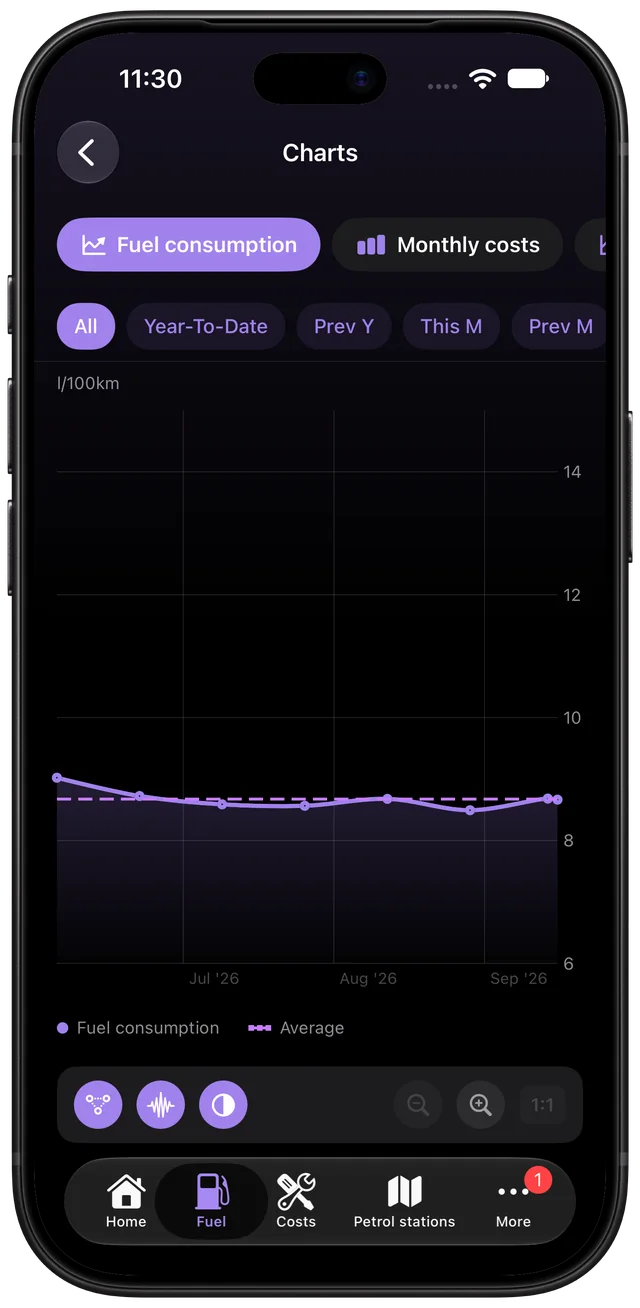
- An app on your phone takes the entry at the pump, does the division and draws the charts. A fuel log app like Fuelio also keeps cost per distance, handles partial fill-ups and exports to CSV if you want the spreadsheet as well.
The best method is the one you'll actually keep up. A log with gaps gives you wrong numbers.
Tracking more than one vehicle
If you drive a car and a motorbike, or look after a family fleet, keep a separate log for each vehicle. Mixing them makes every average meaningless. In Fuelio each vehicle has its own fuel type and units, so one can be in MPG and another in l/100 km, and you can switch between them in a tap.
What to do with the numbers
Once you have a month or two of fill-ups, three things become useful:
- The average is the number to use for budgeting and for working out what a trip will cost.
- A sudden jump of more than 10 to 15% over your average is worth checking: tyre pressure, a dragging brake, a dirty air filter or a failing sensor.
- The cost per mile or kilometre shows what your driving really costs, and it's the starting point for your car's cost per mile.
Track fuel consumption with the full-tank method
- Fill the tank to full. Fill up until the pump clicks off, and write down the odometer reading and the date.
- Drive as usual. Use the car normally until you need fuel again. Don't reset anything and don't wait for the warning light.
- Fill to full again. Fill up to the first click, then record the new odometer reading, the amount of fuel and what you paid.
- Divide fuel by distance. Subtract the old odometer reading from the new one, then divide the fuel you added by that distance. Repeat at every fill-up.
Questions about this
How often should I check my fuel consumption?
Record every fill-up, but judge the figure over three to five tanks. A single tank can swing 10% or more because of the pump click, a cold start or one long motorway run.
Why does my consumption change from tank to tank?
Weather, tyre pressure, short trips, air conditioning, roof boxes and driving speed all change it. Winter figures are usually worse than summer ones, so compare the same season year to year.
Learn more: Fuel Log