How much does your car cost per mile?
Work out your car's real cost per mile or kilometre: add up a year of fuel, insurance, service and fees, divide by distance. Worked example included.

Add up what you spent on the car over a year and divide by the miles you drove. Someone who spent £3,370 and covered 8,400 miles paid about 40p per mile. Fuel is often only about half of that, which is why the number surprises most people the first time they calculate it.
A worked example
Here is a year of costs for a mid-size petrol car:
| Cost | Amount |
|---|---|
| Fuel | £1,650 |
| Insurance | £720 |
| Service and repairs | £540 |
| Car tax and MOT | £250 |
| Parking and tolls | £210 |
| Total | £3,370 |
The odometer went from 40,100 to 48,500 miles, so the car covered 8,400 miles. £3,370 ÷ 8,400 = £0.40 per mile, or about £281 a month.
Fuel alone works out at £1,650 ÷ 8,400 = 20p per mile. The other 20p are the costs people forget when they say a trip "only costs the petrol".
Running cost or ownership cost?
The figure above is a running cost. It leaves out depreciation, the value the car loses each year. If this car was worth £1,800 less at the end of the year, the full cost of ownership is £5,170, or 62p per mile.
Use the running cost for monthly budgeting. Use the ownership cost when deciding whether to keep a car, replace it, or compare it with a lease or car sharing.
Per kilometre
The method is identical in metric. The same year is about 13,500 km, so £3,370 ÷ 13,500 = 25p per km. If you need to switch, one mile is 1.609 km, so a cost per mile divided by 1.609 gives cost per kilometre: 40p ÷ 1.609 = 25p.
Why the number moves
Cost per mile isn't fixed. It drops as you drive more, because fixed costs like insurance get spread thinner, and it jumps in a year with a big repair. Fuel price changes move it a little; a new set of tyres moves it more. Looking at it year on year tells you whether an older car is starting to cost more than it's worth.
Getting the inputs right
The calculation is only as good as the log behind it. A missing insurance payment or a forgotten set of tyres can understate the result by 10% or more. The guide on tracking car expenses covers what to record. For the fuel part, use your measured consumption (how to calculate MPG) rather than the official figure.
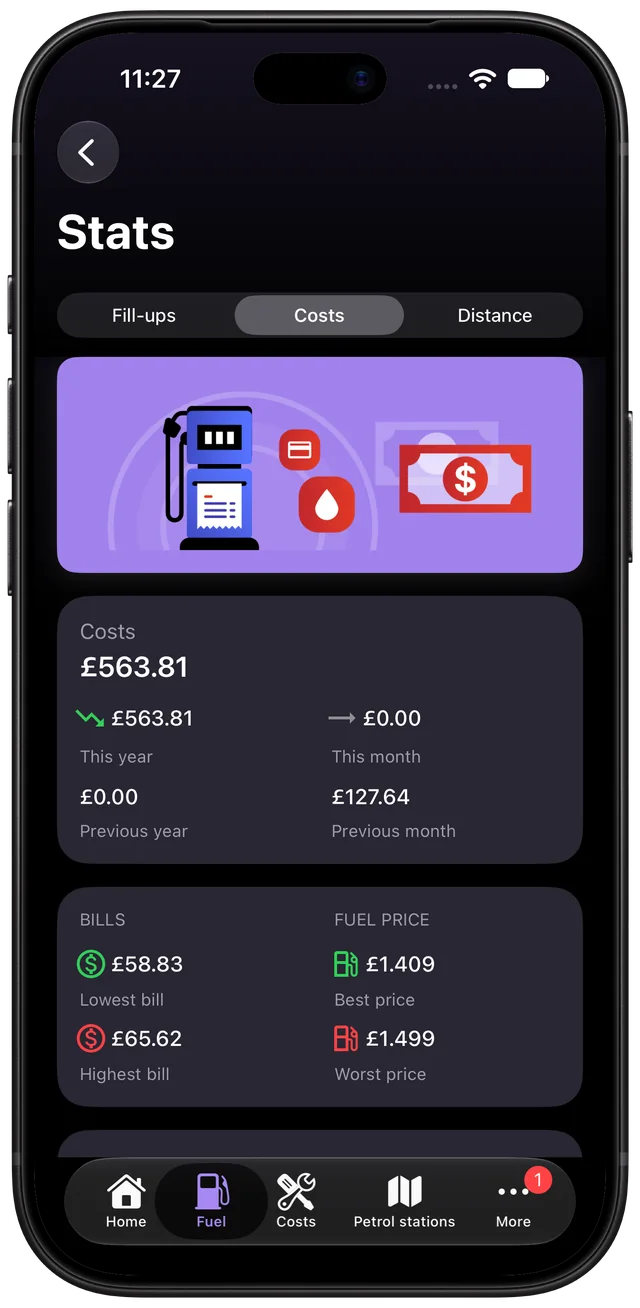
Fuelio works this out for you. The cost stats screen* shows your average cost per mile for all costs together, and for fuel alone. The fuel log shows it for every fill-up, using the price of the fuel you burned on that stretch (how it is calculated). For a chosen period, or to include what the car lost in value, create a Cost of Ownership report*: enter what you paid and what the car is worth now, and it also shows cost per month and per day. More about stats and reports.
* On iPhone, costs are part of Fuelio Premium. On Android they are free.
Calculate your car's cost per mile
- Total a year of running costs. Add fuel, insurance, service, repairs, tyres, car tax and MOT, parking and tolls.
- Find the distance. Subtract the odometer reading at the start of the year from the reading at the end.
- Divide. Divide the total cost by the distance to get cost per mile or kilometre.
- Decide on depreciation. For the full cost of ownership, add the value the car lost that year and divide again.
Questions about this
Should I include depreciation?
Include it when comparing owning with leasing or replacing the car, because it is often the largest single cost. Leave it out when budgeting monthly cash, because you don't pay it until you sell.
Why did my cost per mile go up when I drove less?
Insurance, tax and depreciation are paid whether the car moves or not. Spread over fewer miles, each mile carries more of them. Fuel per mile stays roughly the same.
Learn more: Stats & Reports