How to calculate your car's MPG
Calculate your car's MPG with the full-tank method: miles driven divided by gallons used, worked out from the litres you pump. Worked examples.
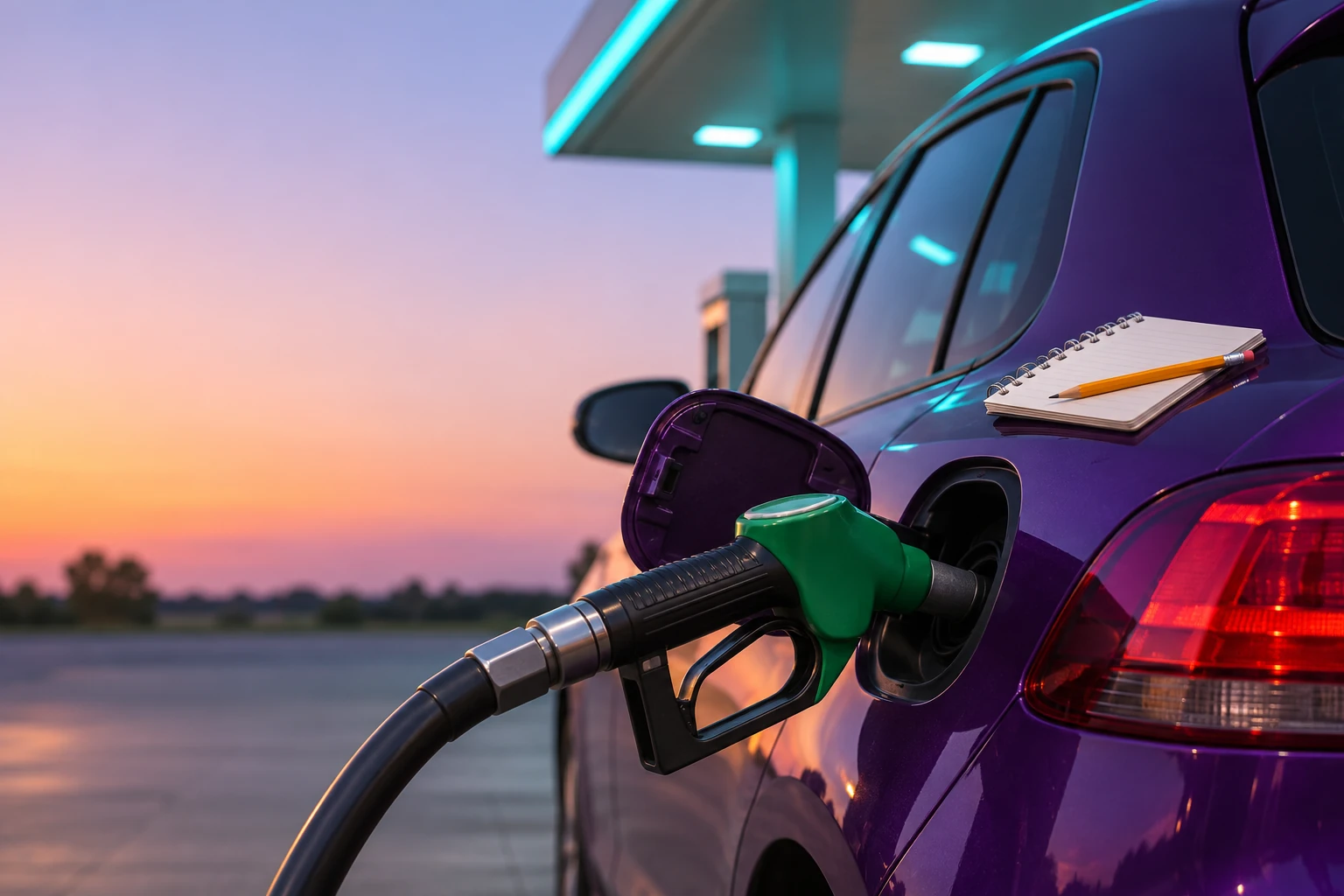
Divide the miles you drove since your last full tank by the gallons it took to fill up again. UK pumps show litres, so first divide the litres by 4.546 to get imperial gallons. If you drove 312 miles and the pump showed 35.5 litres, that is 35.5 ÷ 4.546 = 7.8 gallons, and 312 ÷ 7.8 = 40.0 MPG. That is the whole formula. The tricky part is collecting the two numbers consistently.
To skip the sums, type the miles and the litres into the fuel calculator and it gives you MPG, l/100 km and km/l.
The full-tank method, step by step
Start with a full tank. Fill until the nozzle clicks off and write down the odometer reading, say 41,250 miles. Drive as you normally would. When you come back to the pump, fill to the first click again and note two things: the new odometer reading (41,562) and the litres dispensed (35.5).
The distance is 41,562 − 41,250 = 312 miles. Because the tank was full at both ends, the 35.5 litres you just bought is exactly the fuel those 312 miles used. Convert it to gallons (35.5 ÷ 4.546 = 7.8), divide the distance by it, and you have your miles per gallon.
A full tank is the only fuel level you can reproduce reliably. The needle on the gauge is not precise enough.
What if you didn't fill the tank all the way?
Partial fill-ups happen. You top up with a few litres on a busy morning and fill properly a few days later. You can still get an accurate number if you keep every receipt in the chain.
Add up all the fuel bought after the last full tank, including the partial ones, and divide by the distance from that full tank to the next one. Example: full tank at 41,562 miles, then 15.9 litres at 41,700, then a full fill of 25.9 litres at 41,930. The distance is 368 miles and the fuel is 41.8 litres, which is 9.2 gallons, so 368 ÷ 9.2 = 40.0 MPG.
The mistake people make is to calculate MPG from the partial fill-up on its own. A top-up on its own tells you nothing about how much fuel left the tank since the last fill.
No full tank? Use the tank level
You can also get a figure when you never fill to the brim. If you know the tank size and roughly how full the tank is, the gauge tells you how much fuel is missing from a full tank, and you add it to what you bought.
Example: a 45-litre tank is full at 41,250 miles. At 41,562 you add 31.0 litres and the tank is about 90% full, so it is 4.5 litres short of full. The fuel used was 31.0 + 4.5 = 35.5 litres, which is 7.8 gallons, and 312 ÷ 7.8 = 40.0 MPG.
This is an estimate, so full tanks stay the most accurate. It is handy for cars you only ever top up, or when you forgot to fill to the click.
UK gallons, US gallons and l/100 km
An imperial (UK) gallon is 4.546 litres and a US gallon is 3.785 litres, so the same car shows a lower MPG figure in the US. To convert UK MPG to US MPG, divide by 1.201: 40.0 UK MPG is about 33.3 US MPG.
Most of the world measures the other way round, in litres per 100 kilometres. To turn UK MPG into l/100 km, divide 282.5 by the MPG: 282.5 ÷ 40.0 = 7.1 l/100 km. There is a separate guide to l/100 km with metric examples.
Getting a number you can trust
One tank is a sample. Weather, traffic, a roof box or a week of short trips can move the result by 10% or more. Track every fill-up for a month or two and look at the average. You will also see patterns: winter tanks are usually worse, and long motorway runs usually better.
Be consistent about the pump. Stop at the first click instead of rounding up to the next pound, and use the same side of the station if you can, since some forecourts slope.
Letting an app keep the log
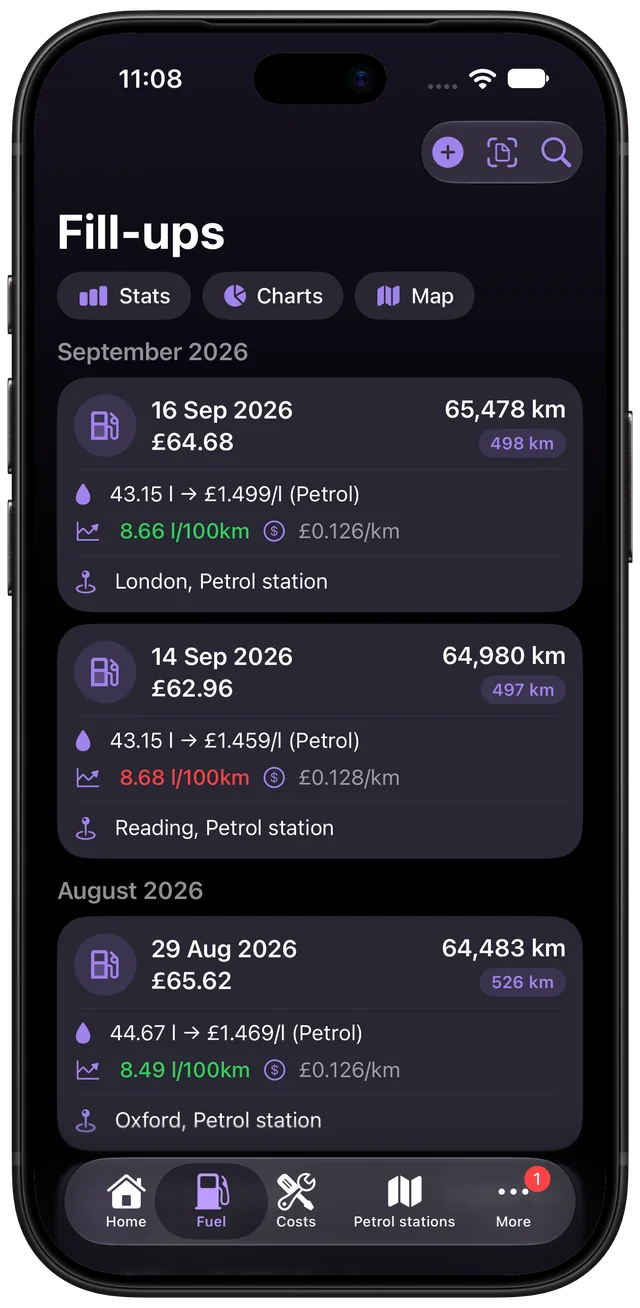
Doing this on paper works, and plenty of drivers kept a notebook in the glovebox for years. An app removes the arithmetic and keeps the history. In Fuelio you enter the odometer and the litres at each stop (or scan the receipt*), mark whether the tank is full, and the fuel log, also called the mileage log, works out MPG, l/100 km or km/l for every tank, including partial fill-ups, plus your long-term average. If you set the tank capacity, a partial fill-up can carry a tank level estimate too, so it counts like a full tank without filling to the click. Missed a fill-up? Mark it and Fuelio skips that stretch instead of showing a wrong figure.
Once you have a real MPG, the next questions are usually how much a trip will cost and what the car costs per mile overall.
* Part of Fuelio Premium.
Calculate MPG with the full-tank method
- Fill up completely. Fill the tank until the pump clicks off and write down the odometer reading.
- Drive normally. Use the car as you usually do until you need fuel again. A full tank of driving gives a steadier figure than a few miles.
- Fill up completely again. Fill to the first click again and note the odometer and the litres the pump shows.
- Convert litres to gallons. Divide the litres by 4.546 to get imperial gallons.
- Divide miles by gallons. Subtract the first odometer reading from the second, then divide that distance by the gallons.
Questions about this
Does it matter where the pump clicks off?
A little. Pumps stop at slightly different levels, so one tank can read high and the next low. Stop at the first click every time and look at the average over several tanks rather than a single result.
Why is my MPG lower than the figure on the car's dashboard?
Trip computers estimate fuel flow and often read a few percent optimistic. The pump measures what actually went into the tank, so the full-tank figure is usually the more honest one.
Learn more: Fuel Log