How to calculate fuel consumption in l/100 km
The l/100 km formula with worked examples: litres used ÷ kilometres driven × 100. Plus km/l, converting to MPG and handling partial fill-ups.

Take the litres you put in, divide by the kilometres you drove on them, and multiply by 100. A car that used 42 litres over 600 km consumes 42 ÷ 600 × 100 = 7.0 l/100 km. Lower numbers are better: a car at 5.5 l/100 km needs less fuel than one at 7.0.
The formula with a real fill-up
l/100 km only works if you know exactly how much fuel the distance used, and the simplest way to know that is to start and finish with a full tank.
- Fill up until the pump clicks off. Odometer: 58,320 km.
- Drive normally.
- Fill up to the click again. The pump shows 42.0 litres and the odometer reads 58,920 km.
Distance: 58,920 − 58,320 = 600 km. Consumption: 42.0 ÷ 600 × 100 = 7.0 l/100 km.
km/l: the same idea upside down
In parts of Asia and Latin America, consumption is quoted in kilometres per litre. Using the same numbers, 600 ÷ 42 = 14.3 km/l. To switch between the two, divide 100 by either value: 100 ÷ 7.0 = 14.3 km/l, and 100 ÷ 14.3 = 7.0 l/100 km.
Partial fill-ups
If you add 20 litres halfway through a tank without filling it, keep that receipt. At the next full fill-up, add together every litre since the last full tank and divide by the whole distance. Calculating consumption from a partial fill-up on its own gives a meaningless number, because you don't know how much fuel was in the tank before.
Converting to MPG
Visitors from the US and the UK often quote miles per gallon. The conversions use two fixed constants:
| From l/100 km | Divide this number by your l/100 km |
|---|---|
| US MPG | 235.2 |
| UK MPG | 282.5 |
So 7.0 l/100 km is 33.6 US MPG or 40.4 UK MPG. The MPG guide covers the calculation in miles and gallons.
The fuel calculator converts between l/100 km, km/l, UK MPG and US MPG as you type.
Why your figure differs from the official one
Type-approval figures (WLTP in Europe) come from a lab cycle. Real driving includes cold starts, air conditioning, traffic and roof boxes, so most drivers measure somewhat more than the brochure says. Your own figure, averaged over several tanks, is the one to use for budgeting and for estimating what a trip will cost.
Doing it automatically
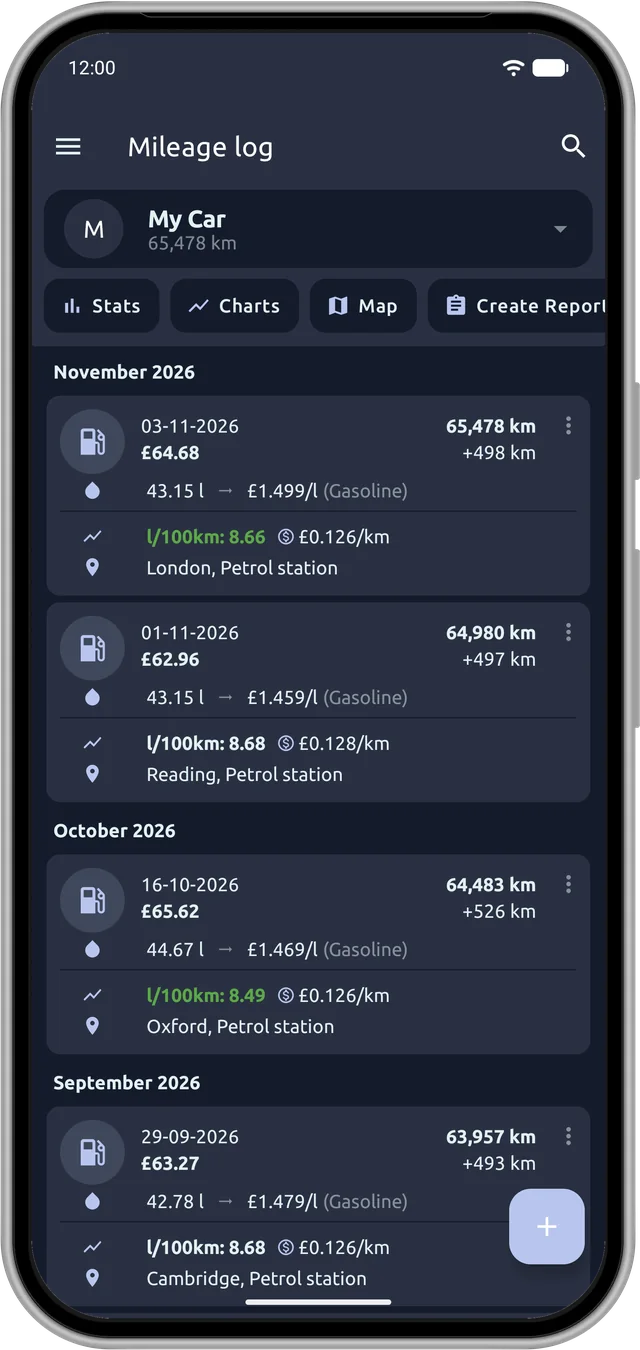
In Fuelio you choose l/100 km, km/l or MPG for each vehicle and enter the odometer reading and litres when you fill up. The fuel log, also called the mileage log, keeps the per-tank figure and the long-term average, and works with LPG, CNG (in kg or m³) and two-tank cars too. If you drive a bi-fuel car, see how to track LPG consumption.
Calculate l/100 km from two fill-ups
- Fill the tank. Fill up to the first click and note the odometer in kilometres.
- Refill and note the litres. At the next fill-up, fill to the first click again and write down the litres and the new odometer reading.
- Work out the distance. Subtract the old odometer reading from the new one.
- Apply the formula. Divide the litres by the kilometres and multiply by 100.
Questions about this
Why does a lower l/100 km number mean better economy?
Because it measures fuel used per distance. MPG and km/l count distance per unit of fuel, so for those a bigger number is better. For l/100 km, 5.5 beats 7.0.
How do I compare a European figure with an American MPG figure?
Divide 235.2 by the l/100 km value to get US MPG, or 282.5 for UK MPG. A car using 6.0 l/100 km does about 39 US MPG or 47 UK MPG.
Learn more: Fuel Log