How to calculate mileage (km/l) of a car or bike
Mileage in km/l is distance driven divided by fuel used. Worked examples for a car and a bike, plus conversions to l/100 km and MPG.
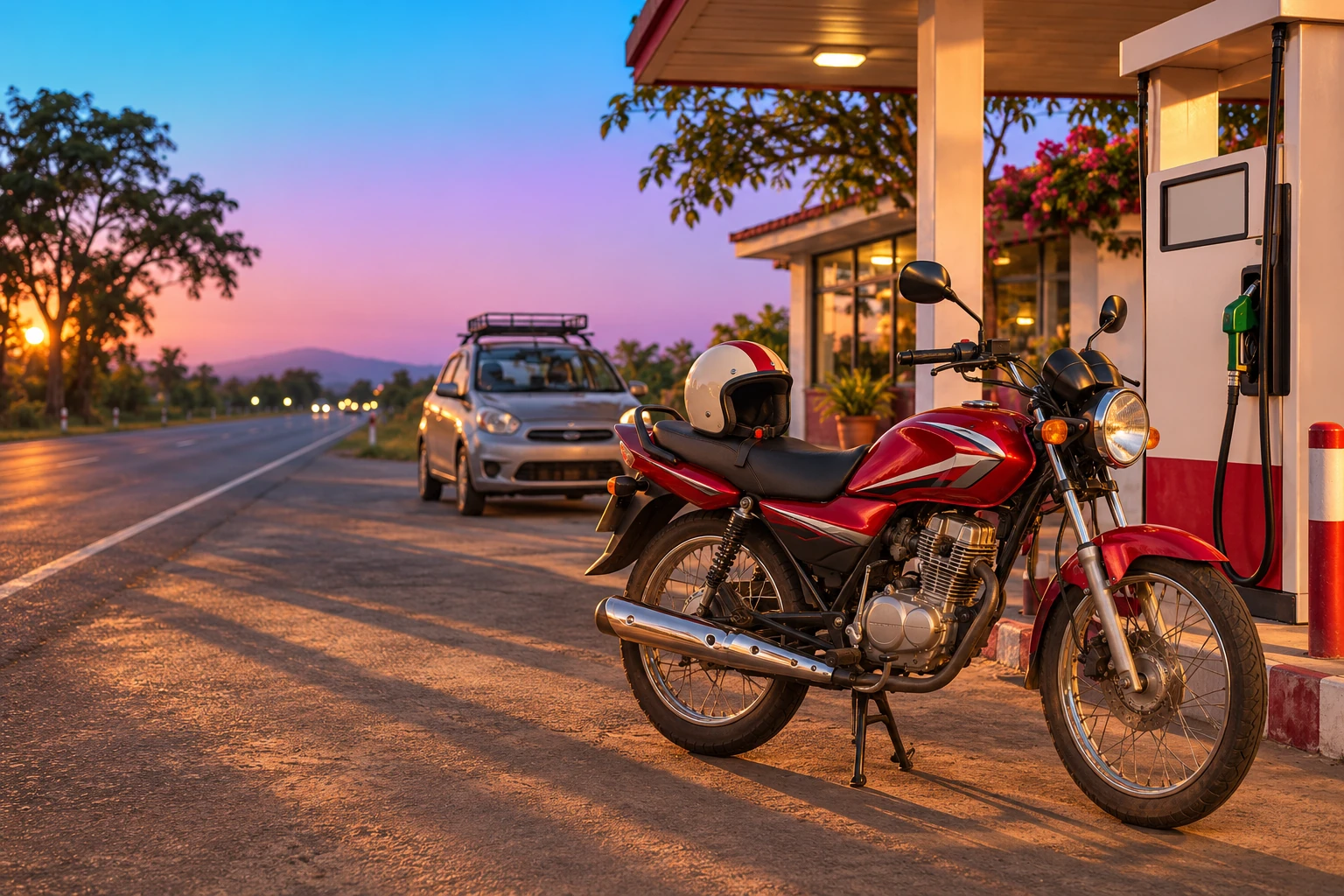
Mileage in km/l is the distance you drove divided by the liters of fuel you used. A bike that covered 180 km on 3 liters has a mileage of 180 ÷ 3 = 60 km/l. A car that covered 450 km on 30 liters gets 450 ÷ 30 = 15 km/l. Higher is better.
"Mileage" has two meanings. In the UK and US it usually means the distance on the odometer. In India and several other markets it means fuel efficiency, and that's the meaning this guide uses.
The tank-to-tank method
You need to know how much fuel a stretch of road used, and the pump is the only reliable meter you have. So fill to the brim at both ends:
- Fill the tank until the pump stops. Odometer: 12,450 km.
- Ride or drive normally.
- Fill to the same level again. The pump shows 3.0 liters and the odometer reads 12,630 km.
Distance: 12,630 − 12,450 = 180 km. Mileage: 180 ÷ 3.0 = 60 km/l.
Fill the same way each time, at the same pump if you can, with the vehicle standing level. A bike's small tank makes any difference in filling level show up as a big swing in the result, so measure over a few tanks and average them.
Converting between km/l, l/100 km and MPG
All three describe the same thing. To convert:
| You have | To get | Calculate |
|---|---|---|
| km/l | l/100 km | 100 ÷ km/l |
| l/100 km | km/l | 100 ÷ l/100 km |
| km/l | US MPG | km/l × 2.352 |
| km/l | UK MPG | km/l × 2.825 |
So 15 km/l is 6.7 l/100 km, 35.3 US MPG or 42.4 UK MPG. The full l/100 km guide explains why the lower-is-better scale exists, and the MPG guide covers miles and gallons.
The gas calculator does these conversions as you type, and works out mileage from kilometers and liters.
Why your mileage changes
Mileage is not a fixed property of the vehicle. These move it most:
- Speed. Fuel use climbs quickly above cruising speed, on a bike even more than in a car.
- Traffic and short trips. Stop-start riding and cold engines cost fuel.
- Tire pressure. Soft tires add rolling resistance.
- Load. A pillion or a full boot uses more fuel on every kilometer.
- Maintenance. A dirty air filter, a worn chain or old spark plugs lower the figure.
Log every fill-up for a few months and these patterns show up in your own numbers.
Calculating it automatically
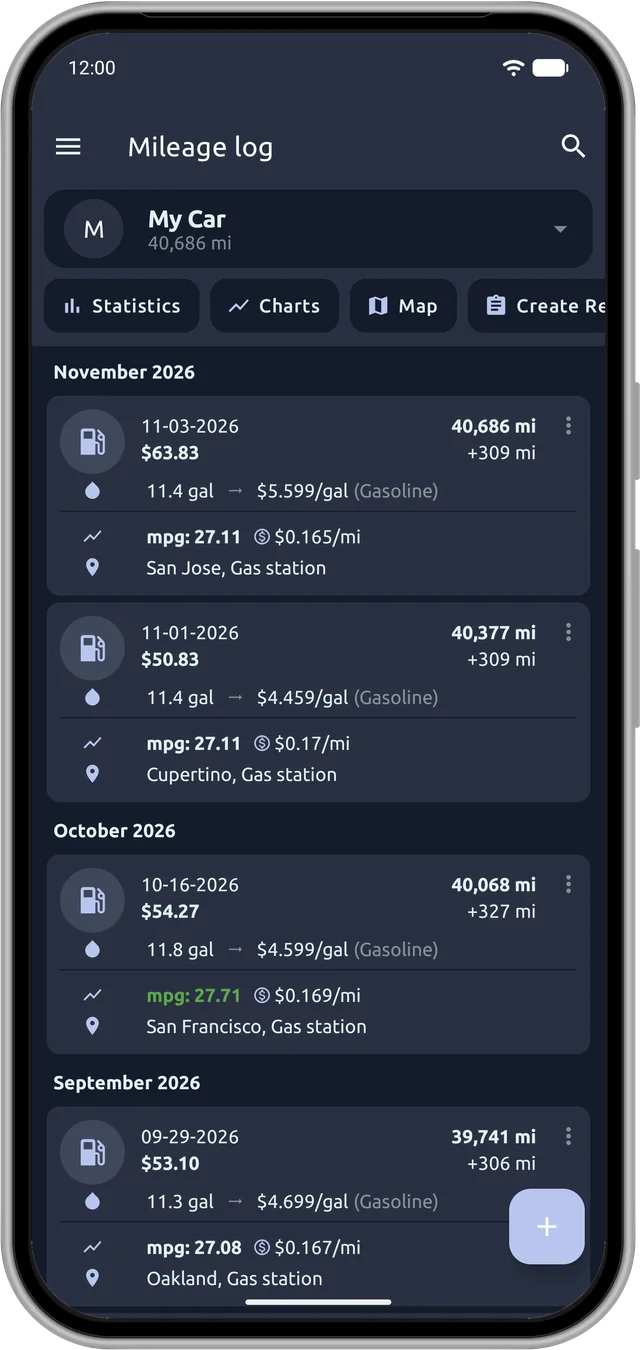
An app does this sum for you. In Fuelio you add your vehicle, choose km/l, l/100 km or MPG, and enter the odometer reading and liters at each fill-up. The fuel log, also called the mileage log, shows the mileage of every fill-up and the long-term average, and it works for any vehicle, including a motorbike or scooter. For a wider view of the routine, see how to track fuel consumption.
Calculate mileage in km/l
- Fill the tank to the brim. Fill up until the pump stops, switch the engine off and note the odometer reading in kilometers.
- Ride or drive as usual. Use the vehicle normally until the tank is low. A few hundred kilometers gives a steadier figure than a short trip.
- Fill to the brim again. Fill up to the same level, note the liters the pump shows and the new odometer reading.
- Divide distance by liters. Subtract the first odometer reading from the second, then divide that distance by the liters you added.
Questions about this
Is a higher mileage figure better?
Yes. Mileage in km/l counts distance per liter, so 60 km/l is far better than 40 km/l. This is the opposite of l/100 km, where a lower number is better.
Why is my mileage lower than the figure the maker quotes?
Maker figures come from a test cycle. Traffic, a cold engine, heavy loads, low tire pressure and high speed all use more fuel, so your own figure over several tanks is the one to trust.
Learn more: Fuel Log