How to track LPG consumption in a bi-fuel car
Track LPG (or CNG) and gasoline separately in a bi-fuel car: log each tank on its own, calculate l/100 km per fuel and compare the real cost per kilometer.
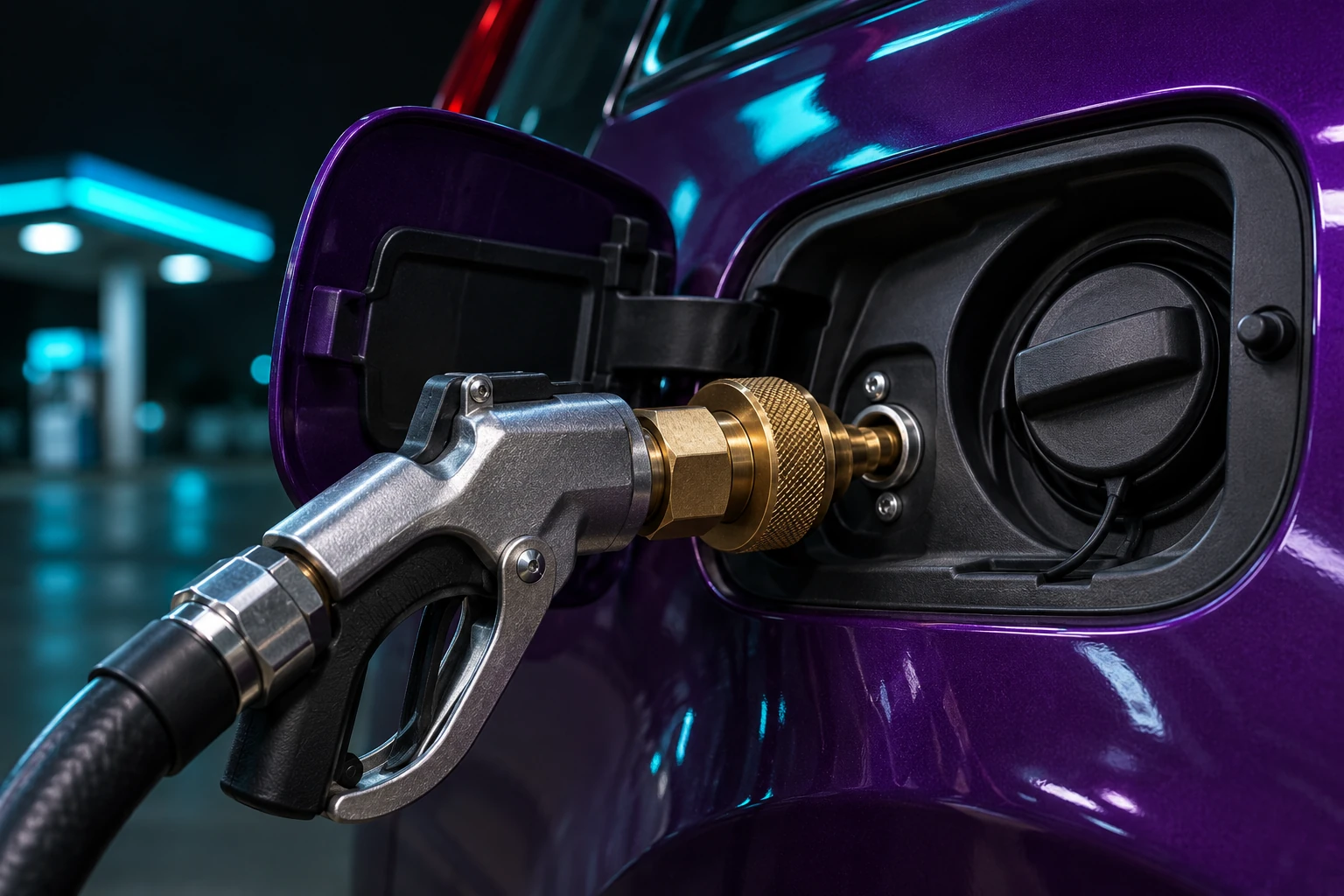
Treat the car as having two tanks and log each one separately. Every LPG fill-up goes against the LPG tank, every gasoline fill-up against the gasoline tank, both with the odometer reading. Then work out consumption for each fuel on its own and compare the cost per kilometer, because LPG cars burn more liters than they do on gasoline.
Why ordinary fuel logs get it wrong
A standard mileage log assumes one tank. In a bi-fuel car you might fill LPG on Monday and gasoline on Friday, and the distance between those two entries was driven on a mix of both. Divide the liters of either fuel by that distance and the result is wrong.
Owners on car forums often fall back to a paper log of every switch between fuels, or create two separate "vehicles" in an app that doesn't understand two tanks. Both work, but both are tedious and make total running costs hard to see.
Setting it up properly
In Fuelio, open your vehicle's settings and switch on Bi-fuel vehicle (2 tanks). Pick the fuel for each tank, for example gasoline for the first and LPG or CNG for the second. When you add a fill-up, you choose which tank it goes to. Each tank has its own unit, so you can use liters for LPG and gallons for gasoline, or kilograms or cubic meters for CNG. Each fuel gets its own consumption figure, worked out from the distance between that fuel's own fill-ups.
If your car is a flex-fuel model that takes gasoline and ethanol in the same tank, don't use bi-fuel. Choose Flex as the fuel type, which lets each fill-up be gasoline or ethanol in one tank.
A worked comparison
Suppose a car does 410 km on LPG and the refill takes 38 liters at €0.89. LPG consumption is 38 ÷ 410 × 100 = 9.3 l/100 km, and the cost is €33.82, or 8.2 cents per km.
On gasoline the same car averages 7.4 l/100 km at €1.72 a liter, which is 7.4 × 1.72 ÷ 100 = 12.7 cents per km.
The car uses about 25% more liters on LPG, yet each kilometer costs roughly a third less. Your numbers will differ with the engine, the conversion kit and local prices, which is exactly why it's worth measuring them.
Tips for accurate LPG figures
- Fill LPG to the automatic stop. LPG tanks are only filled to about 80% by design, and the valve makes that level repeatable.
- Don't mix up the odometer. Record it at every fill-up of either fuel.
- Expect a little gasoline use. Engines usually start and warm up on gasoline.
- Give it a few tanks. As with any fuel, one tank is a sample; the average over a month is the figure to trust.
The general method is the same as for any car, so the l/100 km guide applies to each tank. To put the savings in context, add LPG servicing and the conversion cost to your cost per kilometer.
Track a bi-fuel car
- Set the vehicle as bi-fuel. Give the car two tanks, for example gasoline and LPG, each with its own unit.
- Log every fill-up against its tank. Record LPG and gasoline fill-ups separately, with the odometer reading each time.
- Fill each tank to full when you can. Full-tank fill-ups give the most accurate consumption for that fuel.
- Compare cost per kilometer. Compare what each fuel costs per kilometer, not the liters used.
Questions about this
Why does my car still use some gasoline when running on LPG?
Most converted engines start on gasoline and switch to gas once the engine warms up, and some switch back under heavy load. A small gasoline consumption alongside LPG is normal.
Is LPG really cheaper if the car uses more liters?
Often, yes. LPG usually needs more liters per 100 km than gasoline, but each liter is much cheaper in many countries. Compare cost per kilometer for your own car and local prices.
Learn more: Fuel Log